Unit Economics: The Numbers Behind a Scalable Business Model
Discover how CAC, LTV, gross margin, and contribution margin reveal whether your business can turn customer growth into sustainable, scalable profits.
By CA Aswin
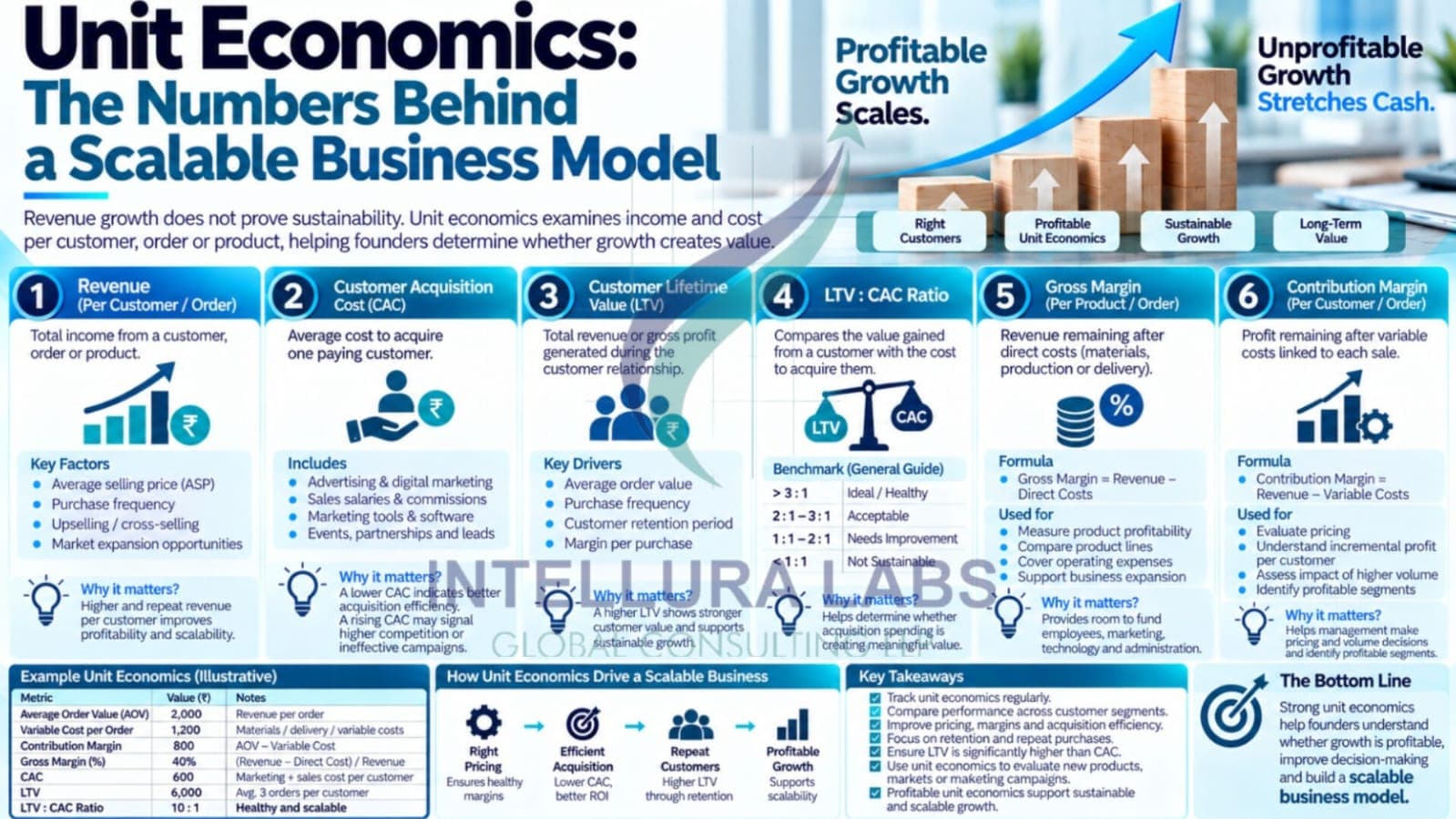
Unit Economics: The Numbers Behind a Scalable Business Model
Revenue growth does not prove sustainability. Unit economics examines income and cost per customer, order or product, helping founders determine whether growth creates value.
Customer Acquisition Cost, or CAC, is the average cost of acquiring one paying customer. It may include advertising, sales salaries, commissions and marketing. A rising CAC can signal declining acquisition efficiency.
Customer Lifetime Value, or LTV, estimates revenue or gross profit generated during the customer relationship. It depends on average order value, purchase frequency, retention and customer life. Comparing LTV with CAC helps determine whether acquisition spending is sensible.
Gross margin is the revenue remaining after direct costs such as materials, production or delivery. It gives the business room to fund employees, technology, marketing and administration.
Contribution margin measures what remains after variable costs linked to each sale. It helps management evaluate pricing, product profitability and the effect of additional volume.
Strong unit economics cannot remove every business risk, but they support scalable growth. These measures help founders improve pricing and judge whether growth is profitable for the business. Founders should track these metrics regularly, compare customer segments and improve the underlying drivers before accelerating expansion.