Cross-Border Transactions: Tax, FEMA and Documentation Risks
Understand the key tax, FEMA, transfer pricing, and documentation risks in cross-border transactions, and how proper compliance can support smoother international business operations.
Cross-Border Transactions: Tax, FEMA and Documentation Risks
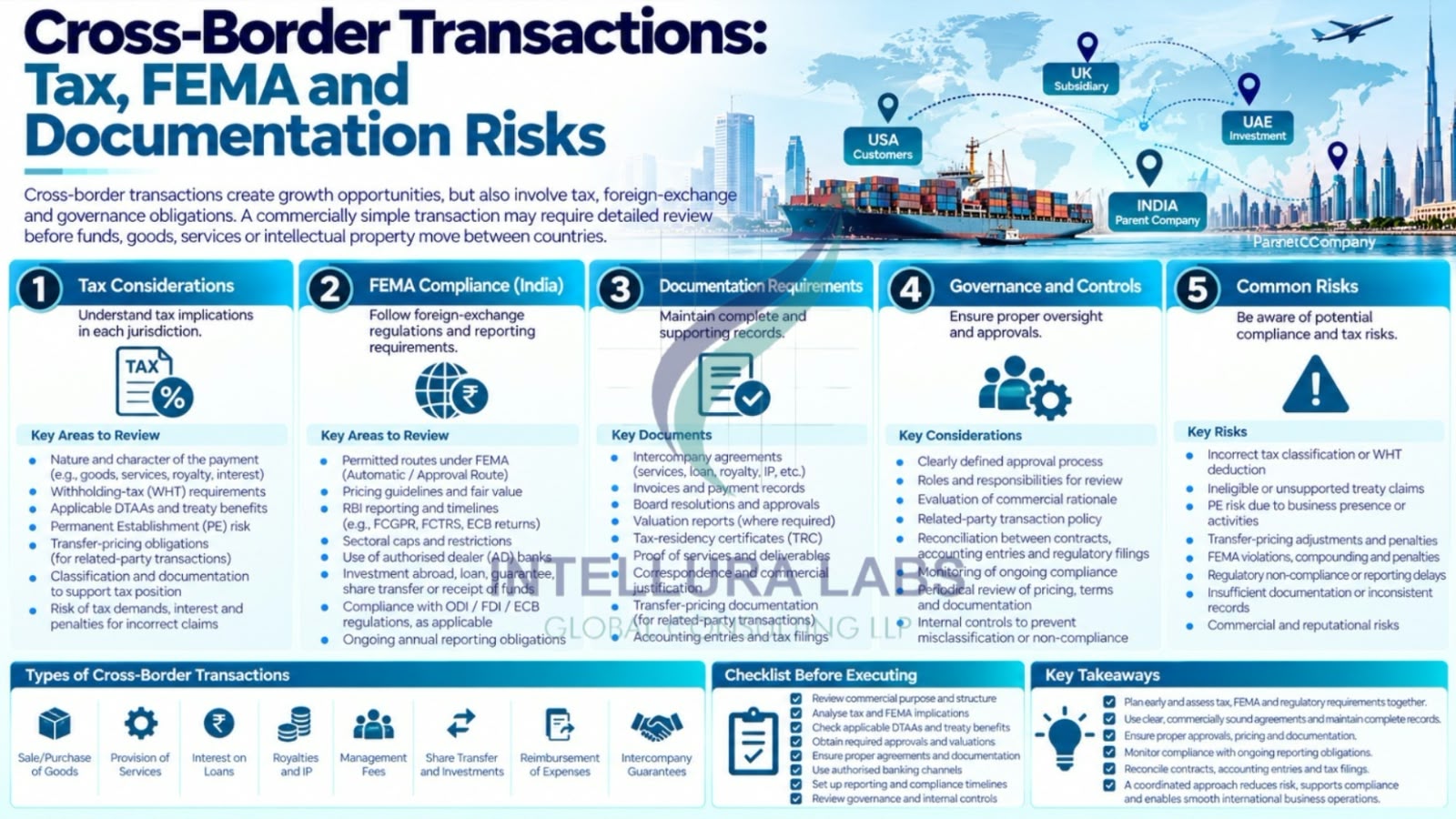
Cross-border transactions create growth opportunities, but also involve tax, foreign-exchange and governance obligations. A commercially simple transaction may require review before funds, goods, services or intellectual property move between countries.
Tax analysis should cover the payment nature, withholding-tax requirements, applicable treaties, permanent-establishment risks and transfer-pricing obligations. Incorrect classification or unsupported treaty claims can lead to tax demands, interest, penalties and disputes.
Foreign Exchange Management Act, or FEMA, compliance is important for transactions involving India. Businesses should examine permitted routes, pricing, reporting, timelines, approvals and restrictions before making investments, receiving funds, extending loans or transferring shares. Correct banking channels and prescribed forms must be used.
Documentation supports defensible compliance. Agreements should describe parties, commercial purpose, consideration, currency, payment terms, responsibilities and risk allocation. Invoices, board approvals, valuation reports, tax-residency certificates, proof of services, correspondence and payment records should be retained.
Governance controls should assign responsibility for review, approval and monitoring. Related-party transactions require transparent evaluation and proper records. Contracts, accounting entries, tax returns and regulatory filings should also be reconciled.
Early review reduces avoidable risk. A coordinated approach to tax, FEMA, documentation and governance helps businesses execute international transactions with clarity and control.